Tag Archives: Ghana

How Ghana does democracy

IBIT Guest Columnist Roxanne L. Scott left a teaching gig in China to become an expat in Ghana, just in time to observe her first African presidential election. Here’s what she saw — and perhaps more importantly, what she didn’t see.


Five Things I Admired About Ghana’s Elections
by ROXANNE L. SCOTT
ACCRA, Ghana — No war. No coups. No vote rigging. A peaceful election with a highly engaged electorate.

Sadly, because of the portrayal of the continent, you may be surprised I’m referring to an African election. Ghana, to be exact.
Roxanne L. Scott
Ghana had their presidential and parliamentary elections this past December, and I had the pleasure of covering them. Here are five things I took away from observing the political process in Ghana.

  1. Political Pride
    Political flags wave in the air. Busloads of people head downtown to one of the many political rallies. Cars and the public transportation minivans I use to commute are proudly draped in the colors and flag of their party of choice. Yet voters are able to put their political differences aside to still communicate and cooperate with each other. It’s electrifying.
  2. It’s a Party, For Real
    In the US, though we have a plethora of political parties, when it comes time to hearing the various voices on the political spectrum, we’re only left with two – Republicans and the Democrats. During Ghana’s presidential and vice presidential debates, all eight parties participated in the debates! This would probably make our heads explode in the States.

    It is true that there are still two major parties in Ghana, the National Democratic Congress (NDC) and the New Patriotic Party (NPP), but hearing alternative voices can open up new ideas concerning society’s ills and political policy.

  3. High Voter Turnout
    When discussing with my editor the benefits of Diasporans being allowed to vote, I made a comment, saying: Well, if you lived outside of Ghana for such a long period of time, would you bother voting? He laughed in my face and said the following words that I’ll never forget: “Ghanaians love to vote.”

    He was right. The 2012 presidential elections had an 80 percent voter turnout.

    Let me write that again — 80 percent voter turn out.

    If we had these numbers in the US, we’d be dancing in the streets. But many would argue that the powers that be would never want us to have these numbers. When providing Election Day coverage and interviewing citizens, many engaged in communal voting, not only seeing it as their duty to vote, but seeing it as their duty to encourage others to vote. The political organization Ghana Decides led a successful campaign to encourage youth voting, much like Rock the Vote in the States.

  4. Ghana Decides

  5. Women and Politics
    There were three women running for Vice President in these elections. Coming from the States, this to me was amazing. Women still hold a pathetic number of seats in parliament in Ghana, and women run into obstacles to running for office, such as raising sufficient funds for a campaign. But seeing these three vice-presidential candidates were inspiring.
  6. Change Makers
    Believe me, there are many problems concerning politics in Ghana. But there is also a hopeful generation that is willing to change that. Political organizations, NGO’s, citizen journalists and the like all recognize the problems and are making waves to solve these problems.

I’m in no means saying that Ghana is a perfect democracy. There isn’t a such thing. But I do think these points above are just many that we in the US can learn from Ghana’s political process.

the IBIT Travel Digest 12.9.12

The good, the bad and the bizarre from the world’s best travel media

HI-YO, PINOT GRIGIO!
Touring wineries and sampling their wares is a big business these days, worldwide. There are escorted winery tours by bus or van, and self-driven wine routes you can enjoy at your own pace by car or bicycle (although you definitely want to go easy on the sampling in both cases).

Napa Valley is even world-famous for its Wine Train, featuring world-cass wines and dinners to match.

It was only recently, however, that I learned that you can tour wineries on horseback. Fresh air and gorgeous surroundings, finished off with some equally gorgeous wines. You can do it either as a day trip or as part of a hotel or bed-and-breakfast stay.

In eastern Washington state and Oregon, up and down California wine country, from Mendocino County in the north to the Santa Ynez Valley and Temecula to the south, or as far off as Argentina and Australia, you can saddle up and get your drink on in the same outing.

I myself am not quite ready for this kind of outing; the only horse I ever rode was made of wood and went around in circles. But for those of you possessing both horse skills and a taste for the grape, this might be a vacation worth considering.

If this sounds like something you might like to look into for 2013, drop me an email at greg@imblacknitravel.com and I’ll send you the information directly.

Just remember to go easy on those samples, lest you get caught galloping under the influence.

-0-

YOUR VOICE MATTERS
Have you ever wondered if all those online reviews people write about hotels actually make any difference? A study conducted at New York’s Cornell University suggests that the answer is a resounding “Yes!”

According to an article in Travel Weekly, the Cornell study showed that good or bad hotel reviews could affect not only room demand at that hotel, but could influence room rates by as much as 10 percent, up or down:

“The study found a direct link between the rise or fall of revenue per available room (RevPAR) and improvements or declines in the online reputation of a hotel, driven by ratings on sites such as TripAdvisor and Travelocity.

To read the entire Travel Weekly story, click here.

Bottom line: Your opinion matters. The Web has given you, the consumer, a more powerful voice than you’ve ever had before. Treat it like the priceless asset it is.

BEST ON A BUDGET
As we know, travel media folks are a bit list-crazy, and never more so than at year’s end. One of the lists you’ll find over at Budget Travel is its 10 Best Budget Destinations for 2013.

Some of their 10 nominees — like Palm Springs, the Bahamas and the Loire Valley in France — are pleasant surprises, because you don’t expect those places to be cheap. Others are a surprise because you’ve never heard of them, like Boracay Island in the Philippines.

And then, there are the ones you’ve heard of, but would never expect to make the list in a million years.

This year’s shocker: Northern Ireland.

To check out the entire Budget Travel list, click here.
-0-

AND FINALLY…
It looks as if Alec Baldwin may get the last laugh, after all.

Remember when the actor/bad boy was famously kicked off an American Airlines flight at LAX last year for refusing the turn off the game he was playing on his cell phone?

Well, almost a year to the day of that incident, the NY Times is reporting that the head of the Federal Communications Commission now says the airlines should allow its passengers freer use of their personal electronics on board aircraft.

FCC chairman Julius Genachowski said as much in a letter last Thursday to Michael Huerta, acting head of the Federal Aviation Administration:

“I write to urge the FAA to enable greater use of tablets, e-readers, and other portable electronic devices during flight, consistent with public safety.”

The magic words there are “during flight.”

Nothing yet from the FAA, which has the last word on the issue, but even that agency has appeared in the past to be leaning in that direction.

It’s been reported in the past, including here on IBT, how personal electronic devices that use radio signals, such as cellphones, have shown signs of interfering with a plane’s navigation controls. But word processing, gaming and other functions would seem to offer little such threat, if any.

Either way, with the FCC more or less getting behind the traveling consumer on this, it could be that we’ll finally see this issue solved for good in 2013.

Meanwhile, if the next TV commercial for a Capital One airline miles credit card features a grinning Alec Baldwin with what appear to be canary feathers in his mouth, you’ll know why.

-0-

And now, here’s The Digest:

AIR
from USA Today
Wouldn’t you know it: The Boeing 787 Dreamliner has scarcely entered service, but technical issues are already starting to surface. In this case, fuel leaks.

from the New York Times
American Airlines pilots ratify a new contract with the airline. For travelers, that means no worries about Christmas holiday trip disruptions. For AA, it’s one step closer to a merger with US Airways.

from ABC News via Yahoo
How bad is internal airport theft by TSA agents? The feds are planting iPads and other consumer electronic devices with GPS tracking devices to see if any of them get stolen…and they are. DO NOT check your laptops, tablet computers or smartphones.

from the Huffington Post
Kate Hanni of FlyersRights says the airlines are sticking it to travelers this holiday season with deceptive pricing and hidden fees, especially baggage fees. Bah humbug!

from Agence France-Presse
A French court has cleared the former Continental Airlines and one of its engineers of criminal responsibility for a deadly 2000 crash of a Concorde supersonic airliner in Paris. Civil liability is still on the table, though.

LAND
from NBC News
Here we go again…a simple device small enough to hide in a Magic Marker can let thieves open the electronic door locks at several major hotel chains nationwide. We’ve reported this before. Yikes. The hotel chains know about it, but have yet to correct it. Double yikes.

from the New York Times
Do you love skiing so much that you wish you could do it all year round? Have some frequent -flier miles saved up? Because if you’re willing to travel, you could ski 12 months out of the year, including in a few places you might never expect.

from Budget Travel
There are lots of folks who prefer to travel by themselves, and across much of the world, solo travel is perfectly fine. But there are some places where it’s really better to go with a group. Here are eight of them. SLIDESHOW

from Travel Weekly
The Hyatt Regency in Chicago begins the second phase of a $110 million renovation.

from SFGate
Wanna get high? I mean really high, as in “those ants down there are actually people” high. Destinations to take you up, up and away.

SEA
from Travel Weekly
Plans by Royal Caribbean International to build a third Oasis of the Seas-class cruise ship may have run aground in Helsinki. The vessel would be built in Finland, but Finnish government is balking at financing the build.

from Travel Weekly
Apparently, not all the cruise lines are holding their noses at the European market. Norwegian Cruise Lines is hooking up with Gate 1 Travel to offer European combination cruise-land tour packages next year, starting with Italy. If they find a way to work affordable airfare into the package, this could be very interesting.

from USA Today
The luxury small-ship Windstar cruise line is offering some end-of-2012 deals on its Northern European cruises, including two-for-one sales.

from USA Today
The weather doesn’t just pick on the airlines. High winds in Cape Town, South Africa force a cruise ship to stay at the dock…for four days.

-0-

AFRICA
from allAfrica.com
New air services in the works for Mozambique, including flights from the capital Maputo to an island resort.

from T. Rowe Price
Ghana, now in the process of peacefully holding a presiddential election, could be the next rising financial star on the Mother Continent. So say these guys, who see five new economic powerhouses on the African horizon — in the west, east and south.

AMERICAS
from The Guardian (London UK)
Good news for those who’ve traveled to Cuba or are planning to go: Thanks in part to an easing of government restrictions, the food is getting better. Much better.

from SFGate
Arizona has a world-famous wave. But leave the surfboard at home, because this one is solid layers of multicolored sandstone millions of years old in remote southwestern desert. This is one vacation that will make you work.

ASIA/PACIFIC
from CNN Travel
Singaporeans may have an international reputation as being cold fish emotionally, but they’re passionate when it comes to cooking in what some consider the capital of Asian cuisine — and for some remarkably low prices, they’ll show you how Singapore cooks.

from CNN Travel
The best places to shop in Beijing…and some cool places to shop in Shanghai.

EUROPE
from Girls’ Guide to Paris
Ah, Paris, how can I tour thee? Let me count the ways. By foot. By Metro. By tour bus. By bike. By…Segway? Oui, Segway.

from Context Travel
A 3.5-hour tour on foot and by Metro of the immigrant’s Paris.

from The Guardian (London UK)
An agritourism project is saving a fading village on the island of Cyprus — and giving travelers something to do other than party the night away in Larnaca.

from the Washington Post
The Louvre, arguably the world’s greatest art museum, is branching out, opens a satellite museum in an old French mining town. Good way to experience the Louvre’s treasures while avoiding the Paris mobs. You can almost hear the ghost of Louis XVI saying, “Damn, why didn’t I think of that!”

from Travel Weekly
If one of your travel dreams is to see the Colosseum in Rome, you probably shouldn’t put it off a whole lot longer. It’s literally crumbling.

Edited by P.A.Rice

the IBIT TRAVEL DIGEST 4.22.12

The good, bad and bizarre from the world’s best travel media.

©James Vallee | Dreamstime.com

AIR
AIRPORT APP
You’re at the airport, with hours to kill before boarding, but your laptop’s battery is running low. Ever wish there were a smartphone app that could not just tell you, but show you where the electric outlets are in your particular airport terminal?

Well, according to the folks at TNOOZ, there is one — or soon will be. It’s called AirportPlugs.

It’s stil in beta test mode, and so far, it’s only set for five airports in the western United States, but you’ve got to love the concept. Can’t wait to see how it looks — and performs — once it’s ready to go.

DON’T TEXT AND FLY
It was bound to happen: An Australian airliner blew a final approach into Singapore’s Changi airport recently. The reason: Instrument interference from the pilot’s cell phone, which he later said he’d forgotten to turn off.

It forced the crew to declare a “missed approach” and go around for a second landing attempt, which is serious business at any airport and led to an official inquiry.

They’re lucky Alec Baldwin wasn’t in the cockpit; the plane might’ve crashed.

CHARGING FOR CARRY-ONS
Allegiant Airlines has become the second air carrier in the United States to charge passengers for stowing carry-on luggage in the overhead bins.

Spirit Airlines, not the most passenger-friendly carrier in the industry, started this nonsense back in 2010. Two years later, Allegiant has seen fit to follow suit. Allegiant president Andrew Levy calls this latest add-on fee part of “an ongoing effort to develop an innovative, new approach to travel.”

I have my own terms for this kind of “innovation,” but I try not to use that kind of language here on IBIT.

-0-

from the New York Times
Take advantage of the federal government’s express check-in programs to speed past security lines. You’ll have to pay for them, but the time saved — and aggravation avoided — just might be worth it.

from the Washington Post
Even as those federal express check-in programs take hold, however, one of them may already be on shaky ground. And wouldn’t you know it, it’s from the TSA. What a surprise…

from USA Today
For the airline business, rising fuel costs are becoming like Jason in all those Friday the 13th horror movies, a killer that won’t go away.

from msnbc
A TSA inspector at Dallas-Fort Worth airport finds an envelope with $9,500 in cash inside…and not only turns it in, but tracks down its owner and returns it to him. There may be hope for this outfit yet.

from CNNgo
Is airline code-sharing dead? The head of an up-and-coming low-fare Asian airline says yes, among other things.

LAND
RENT THY NEIGHBOR’S RIDE?
It was Airbnb that really launched the idea of couch-surfing, travelers saving money by renting rooms in private residences instead of more expensive hotels or even hostels. Now, there’s a new site called Getaround that’s trying to do the same with cars.

It’s still in beta, but it’s a beta worth looking at.

Basically, Getaround connects people looking to rent a set of wheels with individuals willing to rent out their own vehicles by the day or even the hour. It claims to screen the renters, and even provides insurance. The renter gets cheap local transportation. The car owner gets paid.

Couch-surfing…say hello to car-surfing.

-0-

from the New York Times
With travelers able to hunt for bargains and book their own trips online, travel agents looked to be headed for extinction, but it’s not panning out that way.

from USA Today
Five smartphone apps that literally could save your life when traveling overseas.

from CNN Travel
Climate change is gradually turning Greenland into a tourist hotspot. Why? Because so much of its ice has melted that you can actually see the place.

SEA
ANOTHER CRUISE FAIL
The cruise industry has taken yet another hit with reports that the cruise ship Star Princess ignored a drifting fishing boat desperately signaling for help, even after passengers pointed out the stricken boat to a member of the cruise ship’s staff.

By the time help finally reached the boat, two of the three men on board were already dead from hunger and dehydration. In its subsequent apology, Princess said word of the crippled boat never reached the captain nor the officer of the watch.

Do you buy that? Modern cruise ships have powerful radars to detect surface traffic, and bridge officers with binoculars whose job is to scan the waters around them. It shouldn’t even have been necessary for someone to tell the bridge crew about the fishing boat and its frantically waving victims.

When your passengers are more conscientious than your crew, you’ve got a problem.

-0-

from USA Today
If you’re leaving from Seattle on a cruise and need a place to stay before you embark, these hotels come with a “cruise concierge” to help you out.

from USA Today
What do you get when you subject a 15-year-old cruise ship to a $54 million makeover? In the case of Royal Caribbean’s Rhapsody of the Seas, you get a virtually new ship.

from msnbc
With the cruise lines trying to shore up sales in the midst of a problematic year, this might be a good time to score some serious bargains on cruises to the Bahamas.

AFRICA
CRUISING INTO THE FUTURE?
Quiet as it’s kept, the coast of West Africa has enormous potential as a cruise venue, and some folks are positioning themselves to make the most of it.

Already there’s an outfit called G Adventures offering 27-day all-inclusive cruises between Cape Town, South Africa and Dakar, Senegal.

In both time and money, the G Adventures cruises are out of reach for a lot of travelers for now, but they show what’s possible once more competition and more West African ports enter this market.

It’s not hard to envision a great circle trip from the United States — a flight to Cape Town, a cruise with stops along the West African coast, then a flight home from Cameroon, Nigeria or Ghana, perhaps.

It’s going to happen. You watch.

-0-

from IOL Travel
In South Africa, the Protea Hotel Ranch Resort will let you walk with a pride of what it calls “disciplined and well-trained” lions, including three rare white lions. The lions will even let you hold their tails while you walk with them. Am I the only one who finds this disturbing?

from Eyewitness News (South Africa)
South Africa has some of the world’s best surfing. Unfortunately, it also has some of the world’s most dangerous sharks.

from The Star (Kenya) via allAfrica.com
The government is urging Kenyans to embrace wildlife conservation as a way of boosting the country’s tourism.

from The New Times (Rwanda) via allAfrica.com
Another sign that tourism in Central Africa is on the rise: Expedia is expanding its presence in Rwanda.

AMERICAS/CARIBBEAN
AGRITOURISM: A GROWING ATTRACTION IN HAWAII
There’s always been more to Hawaii than pristine beaches, towering waterfalls, volcanoes and big waves. Even the most casual tourist can’t help but notice everything from pineapples to poinsettias, coconuts to coffee beans, just growing wild along the sides of the roads.

It’s as if the islands were a giant collection of farmers markets.

Now, the phenomenon known as agritourism is turning Hawaii’s agriculture into a growing tourist draw in its own right. Farmers markets. Ranch tours on horseback.

And the souvenirs are delicious.

A NEW MONUMENT
Near Monterey on the central California coast — one of the most gorgeous stretches of the Golden State — more than 14,000 acres of federal land that once belonged to the Army’s Fort Ord installation have been designated by the Obama administration as a national monument.

If hiking, mountain biking and camping on rolling hills overlooking the Pacific Ocean sound like your idea of a good time, you’re going to love this place. The fact that you can take one of the world’s most scenic highways to get there — California’s famed Highway 1 — doesn’t hurt, either.

-0-

from the New York Times
Need a reason to visit Bend, OR? If you love lots of good, locally-crafted beers, you’ve already got one.

from USA Today
For those who don’t find the Las Vegas Strip exciting enough, a zipline is being planned between the Luxor and Excalibur resorts, apparently high enough and close enough to McCarran airport that the FAA had to sign off on it first.

ASIA/PACIFIC
REAL LIFE, CHINESE STYLE
If you’re like me, you don’t just want to see “the sights” when you visit a different country. You want to get a feel for what real life looks like — or used to look like — before modernization swept over everything.

If you’re in Beijing, China’s sprawling capital, that means you’ve got to check out a hutong, a traditional Chinese neighborhood.

Many have been torn down to make way for high-rise apartments and office towers, while others are runddown, but a relative handful survive as well-maintained communities and are open to visitors. This slideshow from CNTV lists some of the best to visit in Beijing.

-0-

from CNNgo
At the Bamboo Nest guesthouse in the mountains of Chiang Rai in Thailand, bamboo is everything. and I do mean everything. SLIDESHOW

from CNNgo
Want to play soldier? Then put down the remote, put on your cammo gear and head for the jungles of Thailand, where the Royal Thai Army will put you behind the trigger of an M-16 assault rifle or the controls of a tank. As real as it gets, including the insects you’ll be eating for dinner.

EUROPE
CATALUNYA: VISITORS UNWELCOME?
Spotted this on the TypicallySpanish.com site. Check out what this commenter has to say about Catalunya, a semi-autonomous region where people have a reputation for being fiercely proud of their Catalan heritage:

“…here, not only do most of those involved with tourists refuse to speak English (apologies but it is recognised as the ‘World’ language) – most insist on not speaking Spanish!!! It’s a case of ‘if you can’t be bothered to speak Catalonian, then I can’t be bothered with you, wherever you happen to be from!’ “

If this is true, it’s a real problem for Catalunya and for Spain in general. This is the kind of word-of-mouth advertising no country can afford, especially one in the midst of an economic crisis.

-0-

from The Telegraph (London UK)
Speaking of Spain, an extensive guide to the Andalucia region sponsored by the Spanish tourism folks. Extensive and potentially useful.

from The Guardian (London UK)
The tiny Greek island of Kalymnos is carving out a niche for itself as a destination for climbers and cavers.

from The Guardian (London UK)
Europe has a vibrant, diverse music scene, and that extends to its summer music festivals.

Edited by P.A.Rice

Making a way — to Africa

Latoya Brown is one of IBIT’s Travelers of Color. A few months from now, she’s going to be an Expat of Color, making a new life for herself on the Mother Continent.

We human beings travel for a lot of reasons — for fun, for work, to learn, to grow. If you’re Latoya Brown, you travel with the ultimate goal of trading an old life, whole, for a new one.
Latoya Brown in Ghana
A native of Alabama and currently a resident of Florida, Latoya, 36, is building a career in social media marketing, helping businesses represent themselves on the internet.

She used the Christmas holidays for her first-ever visit to Africa, a 10-day swing that would take her through Ghana and the Cote d’Ivoire, the Ivory Coast.

Her fiance is from West Africa, so it only made sense to introduce herself to his homeland. Especially since, in a few months from now, the two of them plan to marry and live there.

She saw a lot and learned a lot, little things and big things, on that first trip.

She saw the mausoleum of Kwame Nkrumah, the first black president of an independent Ghana, and traveled by bus to Krobo land, where she picked up some of their world-famous trade beads.

She let herself be absorbed into the swirling commercial chaos of the market circle in Takoradi, and got a taste of both villas and village life in Axim. She explored the tropical beauty and walked the rope bridge high above Ghana’s Kakum National Park.

She saw people living in stilt houses built over rivers and coastlines, communities where you do your “commuting” by canoe. She skipped the expensive restaurants at times and ate food bought from outdoor stalls — spicy dishes made from fish, goat meat, rice — “and had no problems whatever.”

Sometimes, they didn’t even bother with the stalls. “We caught our food a lot of days,” she said.

“I live down the street from the water in Florida but the water in the Ivory Coast was so beautiful, just inviting. You’re looking out on the water and the boats and people living on the boats, washing their clothes, everyday living.”

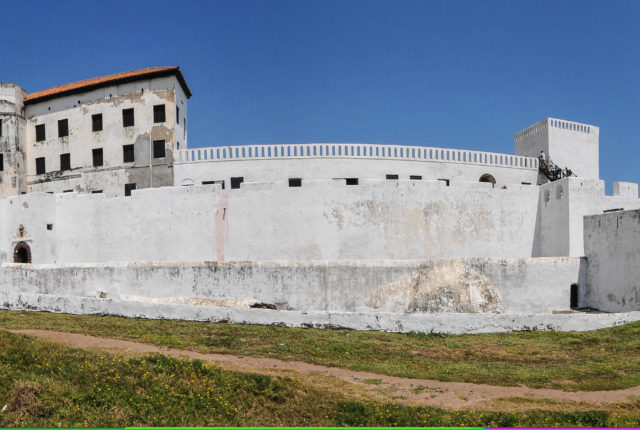
In the Cote d’Ivoire, she visited one of the slave forts from which captive Africans were shipped like cattle into lives of servitude in Europe and the Americas.

“You go down into the dungeons and they turn off all the lights so you can see what it was like, so they can put you in the mentality of the slaves at that moment,” she said. “Then you go the church, which is higher, and the governor’s house, which is higher. They’re all above the dungeons. The idea was, the higher you were, the closer you were to God.”

“Everybody should go at least once and see that place.”

There was a fair number of things that took her by surprise, one of which was the tropical climate. Even coming from St. Petersburg, FL, the humidity in Ghana was an unexpected slap in the face.

“At 5 in the morning in Accra, it was so humid, wow! I went back to the airport,” she said.

In an environment like that, especially if you’re new to it, you need to keep yourself hydrated. But even the simple act of drinking water made for a new experience.

“They drink water out of little plastic baggies. Here, we’re used to drinking out of plastic bottles. Maybe because they’re burning the trash,” she said. “You’re tearing with your teeth and drinking it.”

There were other issues with the water, as well, especially in Axim.

“I was bathing, but the skin was starting to turn the color of the clay. I noticed it on my fingertips and my face,” she said. “I didn’t get sick or anything from it, but I definitely will be getting a filter when I go back.”

Then there were the culture shocks.

“At first, I thought I would just blend in — they’re black, I’m black. It doesn’t quite work that way.”

Ghanaians instantly spotted her as an American, she said. Her insistence on wearing her hair “natural” may have had something to do with that.

“That whole natural beauty thing is a big thing over there. You see the women wearing a lot of wigs, a lot of weaves, so I became this natural beauty that every man wanted to talk to.”

Sorry, fellas, the lady’s spoken for.

“There are still people living in makeshift places; they remind me of huts,” she said. “The women still get the firewood, cook, carrying everything on their heads, while they carry their babies on their backs.”

The Cote d’Ivoire may have been beautiful, but it had its share of culture shocks, as well, starting with the street vendors — “the hagglers,” as she called them.

“The hagglers were so in your face,” she recalled. “They ask you your name and you think they’re just being friendly. Then they come back five minutes later and say, ‘I put your name on this shell, so now you have to buy it.’”

“No, I don’t!”

On the down side, all those weaves and extensions were a bit of a letdown, she said. “And the prostitution in Accra was just…wow!”

But there was one thing that stood out above everything else, she said. That was the acceptance she felt as a black American woman in Africa.

“The acceptance of the Diaspora. Here, you’re kind of battling with people about that, but over there, it’s known and accepted. It’s kind of a pride thing. I was glad to see that.”

Before the year is out, Latoya and her new husband will be seeing a lot more of that as they start their new lives together in Ghana.

Edited by P.A. Rice

ALSO CHECK OUT:
The Africa Page
On my list: GHANA

IBIT Travel Digest

A roundup of the good, the bad and the bizarre from the world’s best travel media

Photo courtesy of Cathay Pacific

THE WORLD IS TRAVELING
According to the UN’s World Tourism Organization, the number of international tourist arrivals worldwide is on pace to hit 1 billion this year. Overall, international tourism was up 4 percent in 2011, coming in at 980 million arrivals.

Europe, Asia, the Americas and Africa all saw their tourist traffic rise last year, with only the Middle East showing a decline, mainly due to the turmoil produced by the Arab Spring.

Not bad for a world supposedly locked in the grip of a recession.

You can check out the details of the UN report here.

COMING TO AMERICA
President Barack Obama used a visit to Disneyworld in Orlando, FL, last week to announce a new initiative to draw more tourists — and their money — to the United States. Its ultimate aim, he said, was to make America the world’s top tourist destination.

It’s centered around streamlining the visa process and making it easier for visitors from friendly nations to come here. For you who prefer your news direct from the source, here’s the White House announcement of the actual plan.

As you might expect, the U.S. Travel Association is ecstatic over this, and for good reason.

Up to now, Washington had more or else taken US-bound tourism for granted, as if international travelers didn’t have alternatives on where to spend their vacations, and their money. The Travel Promotion Act of 2009, also signed by Obama, was the first time ever that the U.S. government set out to promote this country as a brand in the hyper-competitive international tourism market.

Given how lucrative the travel biz is, you have to wonder why.

Tourism generates nearly $2 trillion worth of revenue and 14 million jobs in this country. Any serious effort from Washington to grow those two numbers is something we all should welcome.

But it won’t be a snap. In an exclusive interview recently with IBIT, CBS News travel editor Peter Greenberg described America as “the most unwelcoming nation in the world.”

That may be an exaggeration, but not by much. Between the steep visa fees imposed on many foreign travelers after the 9/11 attacks — mostly on countries friendly to the United States whose citizens took no part in those attacks — and the shortage of immigration inspectors at the nation’s air, sea and land ports, America the Beautiful doesn’t exactly come across as America the Friendly.

We’ve got work to do.

AMERICAN AIRLINES: GOING DOWN?
American Airlines, which recently filed for Chapter 11 bankruptcy protection, could be the next in that long line of US-based airlines of the last two decades or so to be swallowed up in a merger.

According to the Los Angeles Times, both Delta and US Airways are eyeing American as a possible acquisition.

Not sure which of those two I’d prefer to see make that acquisition, but strictly from the consumer’s perspective, it’s hard to see how having fewer national airlines, reduced routes, fewer planes, fewer seats and fewer crews could be viewed as a good thing.


And now, here’s this week’s Digest:

-0-

AIR
from USA Today
Starting next month, American Airlines offering free beer and wine on most overseas flights.

from USA Today
Hairline cracks turning up in Airbus A380 super jumbo jets. European aviation authority ordering inspections.

from d travels ’round
Words of travel wisdom from someone who travels for a living, a merchant seaman.

LAND

from The Daily Meal
East Coast hamburger fanatics, take note: In-N-Out, the Southern California burger chain whose following borders on the religiously fanatical, is planning to expand.

from Rick Steves via Smarter Travel
Lose your bag when you travel? Don’t lose your mind. You will survive this.

from the PlanetD
Can you ride bicycles in Africa and survive? Yes, you can. There will, however, be a few unusual challenges.

from the BBC​
Ways to get around those obscenely high mobile roaming charges when making international calls while you travel. VIDEO

SEA

from News24 (South Africa)
The Costa Concordia isn’t the only hit the cruise industry took recently. The South African government, citing safety concerns, bans cruise ships from docking at Cape Town.

from USA Today
The hits just keep on coming for the ill-fated Costa Concordia. Confirmed dead now at 13, but there may have been unregistered passengers on board, which could push the final death toll higher.

from the Daily Nation (Kenya)
Some in Kenya starting to view the caves used by Mau Mau guerrillas to fight British colonialism as potential tourist attractions. But some of the former fighters themselves are uneasy about that.

-0-

AFRICA

from the Africa Review
Are bogus Chinese constructions firms doing dirt in Ghana?

from Bikyamasr.com
Egypt’s Muslim Brotherhood, which took almost half the seats in the country’s recent parliamentary elections, is telling the country’s tourism sector to relax: No sweeping changes; booze and bikinis for tourists still okay.

from the Zambia Daily Mail
Zambian government, looking to improve all forms of transport in the country, is trying to draw more foreign airlines to Zambia.

from the BBC
Five foreign tourists shot to death in a remote, rugged Ethiopian desert. Ethiopia casts suspicions on neighbor–rival Eritrea.

-0-

AMERICAS/CARIBBEAN

from the New York Times
If the beach crowds in Rio de Janeiro get to be too much, head for an unspoiled alternative, Praia do Rosa.

from BBC Travel
All you tokers, potheads and other recreational herbalists still have a reason to visit Amsterdam, for now — that new Dutch law that was supposed bar non-Dutch citizens from patronizing the Netherland’s famed ​”coffee shops” has been postponed until May.

from the San Francisco Chronicle
Trains don’t usually come to mind when you think of Hawaii. The Kaua’i Plantation Railway could change that.

from the Guardian (London UK)
Sleep tourism? That’s right, I said it! Grenada may be one of the world’s most beautiful places to learn how to beat insomnia. But it’s not the only one.


-0-

ASIA/PACIFIC

from Ready Click and Go
What and where — but mostly how — to eat in China.

from the Guardian (London UK)
And speaking of food in China, the capital of Chinese cuisine may just be Sichuan province, which may have the the most densely packed collection of restaurants and teahouses on Earth.

from The Japan Times
Are your favorite North American and European ski resorts unexpectedly barren of snow this winter? You might want to look to Japan to get your downhill thrills this year.

from The Japan Times
You may have never heard of Nada, Japan, but if you’re a serious lover of sake, it needs to be on your must-visit list.

-0-

EUROPE
from the New York Times
In search of real Dutch food in Amsterdam. Even if you don’t find any, you definitely won’t starve.

from the New York Times
How to hit the ground running for a fun weekend in Hamburg, Germany’s second-largest city.

Edited by P.A. Rice

Stay healthy — get stuck!

© Patricia Hofmeester | Dreamstime.com

“Stuck” as in vaccinated. Failing or refusing to get your inoculations up-to-date when you travel abroad can have some pretty harrowing consequences.

The New Year hasn’t even rung in yet, but the IBIT Family of readers and doers is already on the move.

One expat is leaving Japan for a teaching gig in China, while another in Beijing is looking to make a much bigger jump — all the way to Ghana, to set up her own export business.

Yet another will be couch-surfing in Ghana a week from now.

There are several other IBIT readers, many of them bloggers in their own right, coming and going all over the globe, and you’ll be sharing some of their adventures right here on IBIT.

Can you imagine how much I’m loving all this?

You may be planning your own international trips right now — and I hope you are.

That’s why I took notice when this little item popped up in my email box: “5 Dangerous Vaccination Myths,” the very first of which was this:

“Myth: Vaccines aren’t necessary.

“The only disease that has been eradicated is small pox. Everything else is still out there. Some – like whooping cough and measles – continue to cause disease in the developed world. Others, such as polio, mainly occur in developing nations, but could be reintroduced anywhere, via international travel.”

It won’t surprise you that those last two words hooked my attention immediately.

A lot of the diseases that we here in the United States long ago presumed to have been wiped out are still around beyond our shores, bringing the pain to people all over the world. Tetanus, hepatitis, dengue fever, polio, malaria, to name a few.

I’ve never understood the difference between typhus and typhoid fever; I just know I want no part of either of them.

As of this writing, there are close to 30 major diseases that can be prevented by vaccine. Why would you not take advantage of that?

Some folks have attitudes when it comes to vaccines. They think they’re contaminated or toxic. They think the vaccine itself will give them the very disease it’s supposed to protect them from. They think vaccines are just a big money-making scheme by the drug corporations, and so on and so on.

Or they just think they can get by without being vaccinated.

When it comes to vaccinations, the benefits greatly outweigh the risks — especially when one of the risks is exposing yourself to a potentially fatal disease without them.

As yet, there is no vaccine that can render you immune to malaria, but there are pills you can take that can help fend off the disease while you are traveling in the world’s malaria belt (mainly those countries closest to the Equator).

When I visited West Africa for the first time early last year, my doctor put me on Malarone, a combination of two drugs in pill form. That, combined with good mosquito repellent for both my skin and my clothes, and keeping my arms and legs covered, kept me safe.

Knowledge is power. You can look up medical information on your destination country at government medical Web sites such as the US Centers for Disease Control and Prevention. They can tell you what kinds of dangerous ailments a traveler might be exposed to in a given country, and recommend preventive measures.

Hospitals have travel clinics and there are doctors who specialize in travel medicine. Tell them where you’re going, preferably as far in advance as is practical, and they will hook you up with the appropriate vaccines or pill regimen.

If these medications aren’t covered by your medical insurance, they can be somewhat expensive — but not nearly as expensive as flying home on an air ambulance to a long and uncertain hospital stay.

Bottom line: When you’re planning a trip, you need to put as much thought into your health protection as you do to your airfare and your choice of clothing…and don’t be afraid to get stuck!

Depending on where your going, the doctor’s hypodermic needle could be your best friend.

the SUNDAY TRAVEL DIGEST 9.11.11

A roundup of the good, the bad and the bizarre from the world’s best travel media

Pirogues at the Banjul ferry crossing, the Gambia | ©Greg Gross

THE DOG DAYS OF TRAVEL?
The travel industry has conditioned us Americans to view the Labor Day weekend as the official end of the summer travel season. The folks at Lonely Planet would like to offer a dissenting view.

September, you see, is the start of the “shoulder season,” which just might be the traveler’s best friend. Lots of attractions, smaller crowds, lower prices at hotels, restaurants and the like.

The way they see it, in fact, September may be the best month of the entire year to get your travel on, worldwide.

For a region-by-region LP breakdown of the factors that make September a month to give your suitcase a workout, click here.

THE NORTHERN ROUTE
Back in the day, a little-known way of saving money on flights from North America to Europe was to go via national flag carriers from the northern reaches of the mid-Atlantic. The principal vehicle for this was Icelandair, the national airline of Iceland.

According to the Godfather of Travel, Arthur Frommer, this gambit still works today, but via a different airline.

The best way to save on airfares these days from the States to Europe, he says, to is to begin your journey in Helsinki, the capital of Finland, via the national Finnish airline, Finnair.

You may need to do a stopover in Helsinki to complete your onward journey, bt that’s not necessarily a disadvantage. If anything, it has the added benefit of introducing you to an intriguing part of Europe often overlooked by Americans.

For more details on this northern air route to European air bargains, click here.

WANT TO RAISE YOUR VOICE?
According to msnbc, recently concluded meeting of heavyweight policymakers in airport security, immigration and border control came to a conclusion that should not have required a meeting to reach:

When you travel, the quality of your experience matters.

I can hear your teeth gnashing already as you recall your most recent exercise in traveler’s frustration. I myself would love to have had the chance to introduce them to the blue-uniformed stone-faced Sphinx I recently encountered at the San Ysidro border crossing between San Diego and Tijuana.

But I’d much rather hear from you.

What changes in immigration and customs procedures would you most like to see that would make for a better travel experience?

I’ll be collecting your thoughts, suggestions and ideas until Sept. 30. The best answers will be featured here on IBIT, and also compiled into a report which I will send personally those same policymakers.

Send your ideas and suggestions via email.

Meanwhile, you can read the short msnbc story on the meeting here.

LAST BUT NOT LEAST
And finally, no need to remind you what day this is, or what happened ten years ago.

9/11. The Twin Towers. Al Qaeda. All of that.

We’ve heard a lot of talk about how the world changed on that day. In a decade of traveling since then, I found the world generally to be the same mix of good and evil that it’s always been.

In that same time, I’ve watched us use our newfound fears to justify old-school discrimination and prejudice against anyone perceived as “different.” Seen us frisk little girls and search babies in their diapers at airports, decide that torturing people was okay.

The world didn’t change on 9/11. We did. Mostly for the worse.

So I’m thinking this is a good day to think about who we want to be as a nation. Because in truth, America is the world’s greatest ongoing experiment in nation-building — and the experiment is far from finished.

Those who died on this day weren’t soldiers fighting for a cause. They were largely regular folks like the rest of us — all races, and all religions, just trying to make it.

The best way we can honor them, I think, would be to live our own lives the best we can, treat one another the best we can, and try in our own lives to uphold all those high-sounding values we so often proclaim to the world.

Ultimately, history will judge us not on whether we remember what happened ten years ago today, but on what we do with the memory.


And now, here’s this week’s Digest:

-0-

AIR
from USA Today
United Air Lines says it’s committed to maintaining its Denver hub. The size of that hub, however, is shrinking. That means fewer flights to and from the Mile High City.

from WhichBudget.com
ATRA, the Air Transport Rating Agency of Switzerland, lists the ten safest airlines in the world. Finally, a reason to feel good about US-based airlines.

from the Associated Press via the Seattle Post-Intelligencer
On the other hand, is the rush to automate airline cockpits eroding the stick-and-rudder flying skills of airline pilots?

LAND
from Agence France Presse via France 24
Recession? Terrorism? Who cares? According to the UN’s World Tourism Organuization, international travel for the first half of 2011 is up nearly 5 percent, with South America and sub-Saharan Africa leading the way.

from the New York Times
For the last few years, some small but tech-savvy car-sharing services like Zipcar have been quietly taking a bite out of the rental car business. Now the big boys are firing back, and it’s the biggest of them all that’s leading the charge.

from The Economist (London UK)
Where are the world’s ten most liveable cities? According to The Economist, four are in Australia and a fifth is in New Zealand. Of the rest, three are in Canada and two in Europe. The United States? Dont ask.

from BBC Travel
I’ve said it before: There’s something about a train station. The BBC agrees, and offers proof. SLIDESHOW

SEA
from Atlas Cruises and Tours
Is there really such a thing as free activities aboard a cruise ship? Not only is the answer “yes,” but the list is varies, and rather long.

-0-

AFRICA
from the Daily Champion (Kenya) via allAfrica.com
Kenya Airways is out to become Africa’s air connection to the rest of the world, with Nairobi as its hub. To that end, they’re looking to double the size of aircraft their fleet within five years.

from the News Junky Journal
According to South African research, African tourism grew by more than 10 percent in the first five months of this year. Leading the charge were Tanzania, Malawi, Ghana and Botswana.

from the ​Times of Oman
Kenya reaches out to — and into — wealthy Oman is search of tourists.

-0-

AMERICAS/CARIBBEAN
from BBC Travel
Prohibition my be just a memory, but the underground drinking culture it inspired via the speakeasy still lives — in Philadephia.

from the New York Times
The Dose Market in Chicago is taking the flea market concept and running with it, uptown and upscale.

from the ​San Francisco Chronicle
Lots of tourists fly over or cruise past Hawaii’s active volcanoes. Not many get a look at one from the inside. But you can.

-0-

ASIA/PACIFIC
from NHK World (Japan)
All but forgotten amid the global 9/11 hype, Japan pauses to mark the six-month anniversary of its devastating earthquake/tsunami/nuclear disaster.

from Gadling
There may be more than one Great Wall of China.

from The Guardian (London UK)
Would you take a kayak out into the ocean at night, just to look at the stars? You might if you were in New Zealand.

-0-

EUROPE
​from Rick Steves via the Huffington Post
You’re in Paris for the first time, finally, and the Eiffel Tower is high on your list, even if it’s just to get it out of the way. You can wait in the long high-season lines with everyone else, or you can follow Rick’s advice here.

from Ma View Francaise/My French Life
An expat offers up a decidedly unromantic view of life in the City of Light. Prepare to have a few bubbles burst (or not).

from Nomadic Matt
One of my buds in the travel blogosphere recounts his experiences traveling through Ukraine.

from the New York Times
Catalonia — hiking in the shadow of Spanish volcanoes.

CYCLING: Africa gets her roll on, Part 2

Whether for tourism, competition or basic transportation, Africa is slowly but surely starting to take bicycling seriously.

Africa has been relatively late in embracing the bicycle, but it does seem to be happening.

In South Africa, the bike-sharing schemes popularized in Paris and elsewhere in the world are also being tried in Capetown.

And Zambia, as you can see from the video above, has joined Ghana in producing bikes, serious bikes, made from bamboo frames.

But what about the touring cyclist, the racer? What’s in Africa for them?

The reality is that you can tour Africa by bike, just as you can any other continent in the world.

Some adventurous cyclists organize their own bike tours. I know of at least one young Scandinavian rider who’s training to do the Mother Continent — the entire continent — solo.

If you’re not feeling that adventurous, no worries. There are several companies offering organized two-wheel group tours in several different African regions.

They tend to vary in degree of luxury and degree of difficulty, leaving it to you to pamper yourself or push yourself as much as you like.

To get your research started, here is but a partial list of companies that offer bicycle tours in Africa:

For you ultra-competitive types out there (and you KNOW who you are!), there also are races. Some of them are road races; most are off-road. Some are done as charity fundraisers, the rest simply for the thrill and challenge of competition.

They may not rank with the Tour de France, but they’re no joke:

The other thing you’ll find out in these events is that, little by little, Africans are discovering bike racing, and taking it seriously.

How seriously? Cycle racing is already firmly established in South Africa — everything from classic road and track races to mountain bike and BMX racing — to the point that young South Africans are starting to compete in European road races. In African continental athletic competitions, racers from Ethiopia and Eritrea are starting to gain notice.

And it turns out that some of the best ground for training and racing is in Rwanda. Let’s face it, it’s called The Land of a Thousand Hills for a reason.

In Kenya, meanwhile, as this story from London’s The Guardian newspaper shows, young athletes who traditionally would have been expected to devote themselves to long-distance running are starting to turn to cycling, instead.

Two of them, Zayako Nderi and Samwel Mwangi, actually went to France on their own a few years back to take on the most famous-infamous climb in road racing, the Alpe d’Huez.

This towering mountain in the French Alps is a grueling ascent that has destroyed more than a few professional road racers on the Tour de France. What could a couple of inexperienced Africans do with that?

All they did was post two of the fastest non-race times ever recorded on the mountain.

In other words, they crushed it.

That’s right, cycling world. The Africans are coming.

And you’re free to join the ride.

NOTE: The listing of the above organizations does not represent any kind of endorsement by IBIT or me. I list them here solely as a research aid for anyone interested. As always, do your homework on these outfits before you commit any of your precious time, or even more precious money.

ALSO CHECK OUT:
CYCLING: Africa gets her roll on, Part 1

On my list: GHANA

One of an occasional series

ghana national flag

The world’s fastest growing economy belongs to the country that gave birth to post-colonial Africa — a West African nation without ethnic strife, where Christians and Muslims get along and people turn recycled glass into internationally recognized and wearable art?

I am so there.

Not long ago, I got an email from a young man in Ghana. He wanted to introduce me to the Krobo. He thought I might be interested, so I did a little research.

He was right. And I’m thinking you might also be interested.

I had plenty of reason already to take interest in Ghana.

A population of about 24 million people and home to about 100 different ethnic groups, but without the ethnic conflicts that have devastated some of its neighbors.

The same goes for religion. Ghana is one of the countries on the Mother Continent where the Christian and Muslim populations are living together in harmony. That alone would would be enough to draw my attention.

A culture and history that date back millenia, with multiple peoples and kingdoms. Its place in history as the birthplace of post-colonial Africa — the first nation in sub-Saharan Africa to gain its freedom from Europe.

There’s also is presence on the coast of West Africa, a region with a well-established reputation for its warmth and hospitality to the visitor, and its status as a stable democracy.

Its first president, Kwame Nkrumah, is considered one of the fathers of the pan-African movement. Another Ghanaian, Kofi Annan, made his global name as the seventh Secretary-General of the United Nations.

And while you were being bombarded with nightly news stories about post-election chaos and carnage in its neighbor, the Ivory Coast, you may not have been told that Ghana is considered to have the fastest growing economy in the world, based on data from the International Monetary Fund — just over 20 percent so far this year.

But the Krobo and the Ghanaian bead culture hold a fascination in their own right.

The Krobo
are one of the Ga-Adangbe people, who all told number about 2 million people in Ghana. They live in two adjoining eastern districts in Ghana, Manya Krobo and Yilo Krobo.

The Krobo are world-famous for making glass beads.

They make each bead by hand. It’s a lot of work, and no two beads are exactly alike. All manner of recycled glass is crushed into powder, placed in clay molds and fired in clay kilns.

The Ghanacraft.com site will give you a look at the process.

So will the video below.

TRADE BEADS in AFRICA: A Striped, Checkered History
“Trade beads” are a part of African history. In some places, were a form of currency all the way into the 20th century. But these beads once had another name and another usage.

Initially, these beads were not an African but a European creation, and you need only hear their synonym to understand their original purpose.

They were called “slave beads.”

Europeans gave them to Africans in exchange for everything from palm oil to captives from rival tribes to feed into the European slave trade.

Initially, they were made in Venice, Holland and Bohemia in what is now Germany.

Eventually, Africans began making their own glass beads for their own purposes, and when the slave trade finally died away, they kept using them, wearing them and making them.

Some of the original trade beads used to buy and sell human beings back in the days of the slave trade are still around. They are collectors items of historical importance, highly prized and highly valued.

That value often is used as bait by con artists to rip off the unwary, who often end up paying collectors’ prices for “historic” trade beads which not only have no historical value, but often aren’t even as old as the buyers themselves.

Or their children.

The glass beads being produced by the Krobo today are meant to be seen, worn and enjoyed as decoration.

I’m just at the very beginning of learning about Ghana. Its first 50 years as an independent nation have been anything but smooth, and its still faces the challenges of poverty, infrastructure and corruption that are all too familiar on the Mother Continent.

Still, for such a small country (its entire population roughly equals that of Mexico City), it’s got an awful lot going for it, an awful lot going on, and an awful lot to attract the interest of the traveler.

Ghana is on my list.

CYCLING: Africa gets her roll on, Part 1

What’s a bicycle to you? A child’s toy? A way to burn off some calories? Something to do tricks on? In Africa, it’s a lot more than that.

For me, searching the Web is a lot like travel. I never know where it’s going to take me or what it’s going to teach me.

A couple of weeks ago, a small item on Twitter turned up from a young European cyclist who’s planning a 3,500-mile solo bicycle tour of Africa.

My first reflexive, clichéd thought: He’s nuts. But it made me curious.

So I decided to see what I could find about cycling on the Mother Continent.

Two weeks later, I’m still getting an eduction. It turns out that bicycles are becoming a factor in Africa — not merely for sport or travel, but in its very development, and in ways I never would’ve guessed.

All over sub-Saharan Africa,

For years, individuals and charitable groups have been collecting old bikes and shipping them to Africa to be donated to individuals, families, entire communities. But what's going on now has gone far beyond that.

They're teaching people how to ride. They're teaching bike maintenance and mechanics, even how to manufacture their own bikes. In rural areas, bikes are being used for everything from cargo carriers to ambulances.

Then there’s Craig Calfee of Santa Cruz, CA, a serious bike designer who not only creates bikes out of bamboo, but actually has spent time teaching people in Ghana how to build them themselves.

As you’ll see in subsequent blog posts, they’re doing it now in Zambia, as well.

Am I crazy? Probably. But Calfee is totally serious — and more to the point, so are his bikes.

To understand why is this a big deal, you need to either spend some time in Africa, or just use your imagination.

Imagine that the only water available in your household for the day’s cooking, drinking or any other purpose is in a well two miles from your house. Now imagine that you are the one who will have to walk to that well, pump the water into your bucket or 5-gallon can, and carry it back.

Several times a day, every day of your life.

Imagine that the old joke about having to walk for miles just to get to school every day is no joke at all.

Imagine needing to move 50-pound sacks of rice or cement or some other heavy load, the kind for which we’d simply use a pickup truck. Only you don’t have a pickup and can’t afford one.

This is daily reality for a lot of people in the world, and especially in Africa.

A bike doesn’t need perfect roads, or even paved roads. It doesn’t need expensive gasoline. Unlike the donkey that so many people up and down the Mother Continent still use to haul goods, it doesn’t need to be fed.

And as you can see in the video above, you can carry incredible loads with it.

My admittedly cursory search of the Web turned up 17 different organizations around the United States devoted to getting Africans up and rolling on bikes. I don’t doubt for a minute that there are more:

Akerfa
ARAS
Bikes for Africa
Bikes not Bombs
Bicycles for Humanity
Bicycles Against Poverty
Bikes for Rwanda
Bicycle Uganda
Bikes for the World
Cycling Out of Poverty
IBike.org
Kona Biketown
Mike’s Bikes Foundation
Project Rwanda
Re-Cycle.org
Village Bicycle Project
Wheels to Africa
Zambikes

It’s hardly an all-American effort, either. I found similar groups in Australia, Canada, Denmark, Hungary, Japan, and the United Kingdom.

Most important of all, though, may be the homegrown cycling groups, everything from school groups an competitive racing clubs to cycling activist organizations springing up across the Mother Continent.

To them, this is not just recreation. This is practical, sustainable and potentially life-changing transportation.

Not everyone in Africa views bicycles in such a glowing light, as The Economist magazine pointed out a few years back:

“Cycling enthusiasts blame the sweltering heat, potholes, and the dumping of Chinese bikes unsuitable for glutinous dirt roads for the ascendancy of belching minivans, even over short distances…Indeed, Africans tend to turn their back on bikes as soon as they can afford anything with an engine.”

From one African country to another, good roads, knowledge of safe cycling, use of safety gear like helmets and reflectors are all hit-and-miss (which may well be the worst choice of words ever associated with cycling).

And driver indifference to the presence and safety of riders may be worse in Africa than it is in the United States — if that’s possible.

What’s more, bicycles tend to be viewed with indifference by African government leaders and policymakers who look to the developed world for inspiration in planning transportation — and see nothing but large highways and big cars.

But even The Economist concludes that, despite all the shortcomings and stumbling blocks, “with low purchase and running costs, the humble bike could be a key to mobilising rural Africans and unclogging the cities.”

Maybe that young Dutch cyclist is on to something. Little by little, the Mother Continent is getting her roll on — and not just as practical, efficient transportation.

Cycling for sport, and for travel, also is catching on in Africa.

And that’s next.

NOTE: The listing of the above organizations does not represent any kind of endorsement by IBIT or me. I list them here solely as a research aid for anyone interested. As always, do your homework on these outfits before you commit any of your precious time, or even more precious money.

If anyone would like a listing of cycling clubs or advocacy groups in Africa, please leave me a comment on this blog. And if any of these outfits ask how you heard about them, be sure to tell them about IBIT!

ALSO CHECK OUT:
CYCLING: Africa gets her roll on, Part 2