Tag Archives: Netherlands

AFRICA: The Delta Connection

Delta Airlines flight landing at Lindbergh Field, San Diego | ©Greg Gross

How a US-based airline with no experience in Africa became America’s air bridge to the Mother Continent.

Back in 2006, someone on a trivia Web site asked: “Which US airline will be the first to serve Africa?”

The answer, at the end of that same year, turned out to be Delta.

They currently operate some 60 direct flights a week from the continental United States to:

  • Abuja, Nigeria (the national capital)
  • Accra, Ghana
  • Dakar, Senegal
  • Johannesburg, South Africa
  • Lagos, Nigeria
  • Monrovia, Liberia

By the end of 2010, Delta had flown 2 million passengers to and from the Mother Continent. This is the corporate equivalent of going from zero to 60 mph in about three seconds.

So why did Delta charge into a market the rest of the US airline industry was avoiding?

First, there’s the market itself, which we examined earlier.

According to Olivia Cullis, a Delta spokeswoman in London, African air traffic is expected to grow at more than 5 percent a year for the next the 16 years.

Even so, it took dire circumstances to force this move.

The airline filed for Chapter 11 bankruptcy protection following the 9/11 terror attacks, but the real trigger was an obsolete business model.

For decades, Delta had been the airline of the Southeast, flying people around the region via their Atlanta hub. And as they got bigger, so did their jets, including the ill-starred Lockheed L-1011 TriStar.

When low-fare competitors like Southwest, Spirit and AirTran started showing up with smaller planes that were cheaper to operate, the proverbial handwriting was on the wall.

Only after 9/11 had pushed them to the brink of insolvency, however, did Delta grudgingly begin to read it.

Looking for markets without all those pesky little low-fare airlines, their eyes fell on international routes — and Africa was wide open.

A region with 12 percent of the world’s population but less than 1 percent of its air traffic? What would you call it?

Better still, they didn’t need to spend tons of cash for the wide-bodied jets needed for trans-Atlantic flights. They already had them.

Ms. Cullis describes what happened next:

“We started our service to African initially between Atlanta-Dakar-Johannesburg route. The route had performed extremely well for our codeshare partner at the time, South African Airways.”

It performed so well for Delta that they decided to go it alone.

“SAA was carrying thousands of Delta customers and it made good sense to add our own flight and provide our own long-term commitment between South Africa and Atlanta. The flight did extremely well and there started our Africa strategy, which has grown steadily ever since.”

You could say that:

  • 2007: Delta opens a route to Lagos.
  • 2008: Delta agrees to open service to Monrovia.
  • 2009: Delta begins exploring a possible partnership with an African airline, Nigerian Eagle.
  • 2010: Delta flies its 2 millionth African passenger
  • 2011: Delta agrees to operate scheduled flights between the US and Luanda, capital of Angola.

Meanwhile, Delta is out from under Chapter 11 and back in the game.

This story, however, is still being written. Sixty flights a week to a region the size of Africa is far better than zero, but still not that many.

Go on Delta’s own site and you’ll see that the bulk of its US-Africa flights are still code-shares with other airlines, mainly Air France and the Netherlands’ KLM.

That often means a layover, sometimes even a full day, in a place like Paris.

(Then again, there are worse things in life than being forced to spend a day in Paris…)

Currently, Delta isn’t adding new African routes. If this market is so great, you ask, why aren’t they expanding in it?

The short answer is, Africa is still Africa. Olivia Cullis again:

“Today, many of the age-old African political and infrastructure challenges remain. In terms of setting up new routes, there are still a number of political hurdles to overcome, and the bureaucracy involved is also very considerable.”

There’s also the T-word. You know, the whole terrorism thing? If the federal government isn’t happy with a country’s airport security, our friends at Homeland Security can veto a US airline’s plans to fly there.

Then there’s cost. While trans-Atlantic flights to Europe can be had for under $1,000 round-trip, Delta’s direct flights to Africa can top $2,000…in Coach.

If you want something more comfortable than Sardine Class, you may find yourself spending two or four times that amount.

And you may ask yourself, “How can I afford this?”

Still, for the US airline industry, it’s a beginning. They see the possibilities for bringing American travelers to Africa. And Delta is going for it.

These days, however, they’re no longer going for it alone.

And that’s next.

THE RISE AND FALL OF PAN AM
Prior to Delta, the only other US-based airline to fly a regular schedule anywhere in Africa was Pan American World Airways.

Between the 1930s and 1960s, Pan Am pretty much defined international air travel. The main reason we have jumbo jets today is because PanAm went to Boeing and said they needed one.

That’s how we got the Boeing 747.

Then came the 1973 fuel crisis, and more competition from US airlines. Other countries started subsidizing their own carriers while hitting Pan Am with exorbitant landing fees. The bombing of Pan Am Flight 103 in 1988 scared off passengers.

The company folded in 1991. US airlines would ignore Africa for the next two decades.

All that JAZZ!

If you love jazz and long to travel, are you ever in luck. Every year, hundreds of the world’s best travel destinations also just happen to host some of the world’s best jazz festivals.

Jazz is one of the few cultural creations America can truly call its own, a lively, soulful, passionately expressive style of music that has spread and is respected the world over.

Why then does it seem that people in other parts of the world have more respect for jazz than we do? These, it’s all about rock, country and hip-hop.

Among black kids in particular, jazz seems to be thought of as old folks’ music. When you consider that it was black America that gave jazz to the world in the first place, there’s something especially sad about that.

These days, you often have to hunt for a good jazz station on commercial radio — and in much of America, you won’t find one. Were it not for Internet radio, a lot of Americans might never hear a jazz broadcast.

In your typical music shop, the jazz section will be among the smallest in the store…and you may have noticed it shrinking over time.

AMERICAN MADE, RESPECTED WORLDWIDE
But jazz was more than just America’s first homegrown cultural artifact. It also was America’s first cultural export, and it has spread just about everywhere.

Outside the United States, there is no generation gap when it comes to jazz. It’s as popular with the young as it is with their parents, and new waves of jazz musicians around the world are pushing it forward.

What does all this mean to you as a traveler?

It means that if you want to pack your bags and see the world while you listen to some of its greatest jazz artists in the world — old and new — at the same time, you have a delightfully dizzying array of destinations from which to choose.

All over the world, virtually any time of the year. Straight ahead jazz, Dixieland jazz, “smooth” jazz, Latin jazz, acid jazz, and everything in between. It’s all out there for you.

TOO MANY TO COUNT

My first plan for this blog entry was to count up all the major jazz festivals around the world so you could have your own list of options. When I got to a hundred with no end in sight, I stopped.

Your best bet is to choose a region and pick a season, then do a Web search on your chosen destination along with the term “jazz festivals.” Unless you’re contemplating a vacation in Antarctica or North Korea, you’ll probably find at least one.

One? Between them, the United Kingdom and France at least 30.

Theoretically, you could easily do a summer jazz fest in Britain one night, then hop the Eurostar train under the English Channel the next morning and catch one somewhere in France the next.

After stopping for a leisurely lunch and a kir in a Paris cafe.

Equally short rail runs could take you to major jazz gatherings in Belgium, the Netherlands, Spain, Germany, Italy, Austria.

Denmark? Norway? Sweden? Russia? Ja, ja, ja and da. Finland? Jep! Montreux, Switzerland and island of Malta. Amsterdam and Rotterdam. Europe is awash in jazz.

Not in the mood for Europe? What about Asia or the Pacific? China. Japan. The Philippines. Thailand. India. Indonesia. Hong Kong. Australia. New Zealand.

Prefer to stay a just closer to home? The Caribbean is dotted with gorgeous destinations — and jazz festivals. The Dominican Republic, Aruba, Jamaica, Barbados, Anguilla, Trinidad & Tobago, Cuba.

Want to catch a major jazz festival on the Mother Continent? The Cape Town Jazz Festival in South Africa has got you covered.

If you’ve got some favorite jazz artists, and a part of the world you’ve always wanted to see, the odds are pretty good that at least one of them is playing in festival in at least one of those places in any given year.

GO CLUBBING
If the timing of your vacation won’t allow you to hit the big jazz fests — and given the number of options you have on both side of the Equator, that’s frankly hard to believe — the world’s great cities also are home to many of the world’s great jazz clubs. Especially London and Paris.

Paris, in particular, has a love affair with jazz that goes back to the days of World War 1, when black American soldiers and expatriates introduced it to them, along with gospel music (and you’ll find festivals in Paris for that, too).

For black Americans, Paris is as much the City of Sound as it is the City of Light.

At these varied festivals around the planet, you’ll hear the best jazz artists on the planet — not just the established superstars of the music world, but local and regional greats, up-and-comers whom you might never hear if you had to rely strictly on American commercial radio.

The only downside to that is that your monthly budget for music may go drastically up. But really, is that such a bad thing?

So when you’re ready, start packing, pick your destination, and go take a listen to the sound that America gave to the world!

the SUNDAY TRAVEL DIGEST

Bike parking in Amsterdam

Almost everyone rides bikes in the Netherlands, and you can too, if you know the rules of the game. | © Greg Gross

Are fears of one sort or another putting up walls between you and your life? Some people out there are using travel to punch through those walls.

Andrew Couch is travel blogger writing from Germany. He’s also an American expatriate who picked up one day and left the United States to start a new life in Germany.

No friends, no plan, no nothing. Just went. Incredible, yes?

The miracle of Twitter led me to his blog, And although Mr.Couch is not black, his blog gets to the very heart of why I suspect a lot of “us” don’t travel.

Fear. Fear of how we’ll be perceived, how we’ll be treated. Fear of being met with prejudice, bigotry, racism. Fear of being seen as less than worldly. Or something even more fundamental, fear of the unknown, the unfamiliar, all that talk that we can’t understand and all those signs that we can’t read.

By his own account, Mr. Couch is far from fearless himself, but he travels, anyway — not despite his fears, but because of them. He’s actually using his expat life to attack the fears themselves:

“Travel is my avenue for personal growth. I take the train to talk to people, have time to think and time learning to be alone. I go to places where I don’t speak the language and eat things I don’t recognize to expand my personal comfort zone. All of this in essence to deal with my own personal fears and anxiety.”

Most of us put up walls of emotional sandbags about the various comfort zones in our life. Mr. Couch is busily blowing his up, and travel is his dynamite:

“I tend to add one fear to work on as a goal for each trip. So I use my ability to travel with less fear to treat other fears in my life. With so many various fears of different degrees, travel can offer experiences to deal with those.”

Interesting approach, jah? Could it be that this expat has some things to teach us?

You can read more about Andrew Couch and his approach to travel here.

If we approach it in the right spirit, travel can be a good weapon against all manner of fears, be they fear of different environments, different foods, different people, nations, religions, whatever.

In that way, travel becomes something more than just “chillin’” or “seeing the sights.” And when we come back, we may find that we’ve become something more, something stronger, than we were when we left.

We’re going to look more closely at this topic later. But not much later.

And now, here’s today’s Digest:

from elliott.org
The airline industry says it needs all those irritating add-on fees to keep their businesses afloat. Consumer advocate Christopher Elliott says they’d still be profitable without them…but not by much.

from USA Today
According to the folks at Condé Nast magazine, the best airline in America is…well…British! And the way things are going with airlines in this country, doesn’t that just figure.

AFRICA
from the Guardian (London UK)
Cameroon is Africa unplugged, without no frills, pretenses and no special concessions to tourism. It welcomes you, but on its own terms. All of which intrigues the hell out of David Smith.

AMERICAS
from Reuters via msnbc travel
How to spend a couple of days in New York City without causing your wallet to spontaneously combust.

from USA Today
Do you get your roll on with one engine and two wheels? USA Today offers up a list of ten tantalizing road trips with motorcycles in mind.

from the San Francisco Chronicle
Brace yourself: People actually walk in Los Angeles. It’s legal and everything. And if you confine yourself to the historic and revitalizing downtown, it’s even enjoyable.

ASIA
from The Japan Times
Naka-Meguro — or Nakame to the locals — is a virtual island of tranquility in the midst of high-octane megalopolis Tokyo, including some hole-in-the-wall restaurants that are small of space but big on flavor.

EUROPE
from Monique Rubin
The Netherlands, being flat as a table, is custom-made for getting around by bicycle, even in the major cities like Amsterdam (I’m a witness; there are bikes everywhere in that burg!). But there are a few tricks to doing it right, and this American expat has the 4-1-1.

Two wheels and a boat

Touring the Netherlands by bike or barge — or both

© Photowitch | Dreamstime.com

Being both below sea level and flat as day-old beer, the Netherlands is an ideal country for touring either by bicycle or barge.

Bike touring offers a lot of benefits, especially in bike-friendly European countries. For one thing,it lowers your local transportation costs down to nothing. When you’re traveling, “free” is one four-letter word you’ll always love hearing.

For another, you get to experience what it’s like to ride a bike in a place where folks on two wheels aren’t treated as the enemy by those on four. Drivers there tend to treat cyclists with courtesy and respect (what a concept!), if only because when they’re not behind the wheel, the drivers are often cyclists themselves.

And constantly burning calories with all that pedaling means you can partake of all that delightful European food and drink (almost) without guilt.

If nothing else, you’ll fit a lot easier in that Coach seat on the flight home.

The other good way to see the Netherlands is by boat — specifically, a barge tour. The country — including its capital, Amsterdam — is laced with canals, making a barge a very cool alternative to a bus.

While at this year’s Los Angeles Travel & Adventure Show, I came across an outfit up in Redmond, WA that actually combines the two into a single trip. They’re called Bike & Barge Holland Tours. They’ve got trips going through the end of September.

Not surprisingly, most of their tours focus on the Netherlands’ capital city, Amsterdam, but they also offer trips to multiple Dutch cities and a sweep through the classic (and gorgeous) tulip country, as well as tours that range into nearby European countries like Belgium.

DID YOU KNOW?
Amsterdam is the world’s largest flower market. Most of the flowers you see in your favorite florist on in your local supermarket either came from or through here a day or so before.

The city’s flower trade ranges from a massive warehouse operation buzzing with forkifts, to the world’s only floating flower market, spread out along a row or covered canal barges.

Just try to resist the temptation to pick up one of those cannabis starter kits as a souvenir, okay? Just sayin’…

They even offer a four-country swing through the Netherlands, France, Germany and Luxembourg.

They aren’t cheap — $3,000 to $3,200 — but for the money, you get the use of a bike, a ride leader, almost all meals, museum and ferry fees, and returns to the airport or train station at the end of your trip.

Check here for more information…and tell ‘em I sent you!

Text by G. Gross | Bike pic by Diego Cervo

AVIATION QUEEN: Passport = Freedom

By Benét Wilson
After a good 10-year run, my passport expired on April 10.   I actually almost forgot the expiration date until I found out I needed to travel to Geneva,  Switzerland at the end of the month.  I paid $149 to get an expedited passport, and I’m ready to go.

The U.S. Passport Office mailed back my old passport, and as I looked at it, I started thinking about all the great places I visited during the past ten years. 

The two top destinations were England and Brazil.  I worked for Rolls-Royce aircraft engines for two years, and had to go “across the pond” about 4-5 times a year.  The trick I learned was to fly into Manchester, which has shorter lines, do my work at Rolls’ headquarters in Derby, then take a nice train ride to London for a visit to the executive offices. 

I also stopped off at Harrods’ Food Hall to pick up my favorite teas.

FACT: 75 percent of Americans do not own a passport.
–Pauline Frommer, “Pauline Frommer’s Travel Guides”

I took seven trips to Brazil, covering my time as an aviation journalist and at Rolls-Royce.  Most of my time was spent at the Embraer aircraft factory in Sao Jose dos Campos, but I also managed to get to Sao Paulo and Rio de Janeiro several times.  And if we were ferrying a jet back to the United States, we always stopped off at Belem, which is where the Amazon River flows into the Atlantic Ocean.

I had a visa to China for a trip that would have been really cool if it had happened.  I was supposed to fly a 30-seat jet from Oberpfaffenhofen, Germany, home of the now-defunct Fairchild-Dornier aircraft plant, to Hainan via stops in Turkey, Oman, India, Thailand and Hong Kong.

But I still liked looking at that visa.

I took three trips to St. Martin in the Caribbean for the express purpose of plane-spotting.  The final approach to the airport is right on the beach, and you can sit at the Sunset Bar & Grill with a cocktail while you enjoy watching everything from a Cessna Caravan turboprop to an Airbus A340 jumbo jet land at Princess Juliana International Airport.

And no, the pictures are not Photoshopped–the planes really do fly that close.

And while the Netherlands is now on the euro, the island still uses guilders on the Dutch side.  I also visited Jamaica, Martinique, the Bahamas, St. Croix and St. Thomas, all lovely islands.

But the trip I cherish the most in this passport was a January 2005 trip to Paris.  I’ll outline my love affair with Paris in a future post.  I am a regular listener of NPR, and they did a story about how a temporary ice skating rink was built on the second level of the Eiffel Tower.  Skates and a session were included in the price of the tower ticket.  One of the people interviewed noted that he and his girlfriend were airline employees, so they just flew over on a lark.

At the time, I was working for Delta Air Lines, and a very good friend was at US Airways, so we decided to go on that same lark.  We actually spent more time in line than actually skating, but we still had a great time.  We ended up having dinner with some other airline employees at Willi’s Wine Bar, where we met some great wine distributors from New Jersey and helped them “test” what they wanted to sell in the U.S.

One of my best friends told me she always keeps her passport with her for two reasons:
1) You never know when you’re going to have to leave the country quickly; and
2) you never know when an adventure could be waiting right around the corner! 

So if you don’t have a passport, I encourage you to get one. At the very least, you have a great ID card that no one will ever question!

Text and photos by B. Wilson

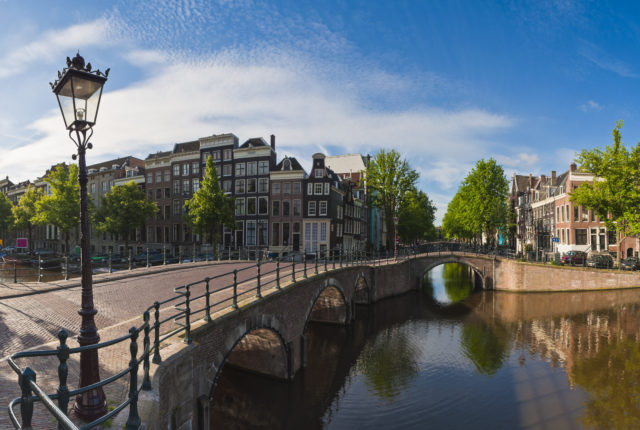
The Netherlands — Engineering on the "down low"

This compact, low-lying, friendly country is worth a look…and so are the measures its people take to protect it.

Netherlands storm surge barrier

Mention the Netherlands among your friends in the States and what you’re likely to get back are:
a) jokes about windmills and wooden shoes, or
b) grins and winks about being able to legally use marijuana or spend time with a prostitute.

Since Hurricane Katrina, however, Americans have found another reason to take note of the Netherlands: The Dutch are the best in the world at keeping low-lying lands from flooding.

And being from New Orleans originally, that intrigues me a lot more than the prospect of blazing up a “doob” or hooking up with “industrial debutantes.”

The last time I was “home” was 2005 as an embedded journalist with the California National Guard, days after Hurricane Katrina. (God bless you guys, wherever you are now).

The levee failures had left 80 percent of the city underwater. There was scarcely a house, a school, a church, a hospital, that wasn’t either flooded or flattened.

We spent our days cruising through neighborhoods in civilian boats, sailing over the tops of cars, past flooded houses and through swamped housing projects, looking for people still trapped in their drowned homes — most of them in my old neighborhood. The disaster has forced nearly all of my family out of the city; most will never return.

Now you know why I have to see the Netherlands.

Flooding in that country is no joke. Sixteen million people live between two major rivers, the Rhine and the Meuse, and the North Sea. Much of the Netherlands — including Amsterdam, its nation capital –rests on land well below sea level.

In their history, the Dutch have lost about 150 villages and towns to flooding. The full number of people who perished in those floods is known but to God.

The North Sea floods of 1953 alone killed more than 2,100 people in Europe. More than 1,800 of those were Dutch.

Model of The Citadel, a planned floating apartment complex to be built in the Netherlands.

So when it comes to flood control, the Netherlands does not play.

FLOATING NEIGHBORHOODS
Giant round swing-out floodgates. Huge storm surge barriers with enough reinforced concrete to build a small town. Inflatable dams. Whole neighborhoods of houses that float. Now, they’re looking to put up floating apartments.

Even more significant, they’re starting to look at ways of working with nature instead of against it as a means of protecting against floods.

Their reputation as flood masters supreme went global after Katrina, and people come from all over the world to see how they do it. Dutch tour operators have caught on to this, and many now offer tours of Dutch flood control works for the lay traveler.

Works for me.

When it comes to holding back floodwaters, the Dutch are so far ahead of us, it’s embarrassing. Or it should be.

And as you can tell from this blogger in the Philippines, anger over half-hearted flood control measures isn’t limited to angry New Orleans folk.

Because it’s about more than just innovative ideas. The Dutch put in the time, the work and the money to do it right. They don’t skimp and they don’t stop.

Of course, there are plenty of other good reasons to visit the Netherlands. Amsterdam is an historic treasure, and I love any city laced with canals and dominated by bicycles. The Dutch people themselves have a reputation for being friendly and welcoming.

Also, after having seen the prototype for Nazi concentration camps in Germany, I have to pay homage to the memory of Anne Frank.

But I have an agenda — and this time, its not just a geek thing. I want to see what flood control looks like when it’s done by people who have their act together.

The shame is that I have to fly across a continent, and then an ocean, to see it.

One bed…two wings…$500 a night

An aerial Cold War relic from the former East Germany lands near Amsterdam…as a hotel for capitalists.

Maybe it’s because I’m only recently back from Germany. Maybe it’s because my ventures into the former East Berlin left me feeling as if not all of the Cold War chill has fully thawed, even after 20 years. Or maybe it’s just that I’m a huge fan of karma when it comes to dictators and tyrants like the late (and largely unlamented) Erich Honecker, the man who brought you the Berlin Wall.

Whatever it is, I can’t help but get a monumental kick out the recent story out of the Netherlands about the Dutch entrepreneur who has fashioned his own little luxury hotel…out of Honecker’s former official airplane!

This story in the German news magazine Der Spiegel will give you the 4-1-1. And just in case you think both they and I are making this stuff up, here’s the video, courtesy of Reuters and Yahoo News UK.

Five stars meets four engines.

This is the equivalent of some Russian nouveau-riche type making a Moscow apartment out of Air Force One.

Sorry, this old converted Russian turboprop airliner/transport/antisubmarine bomber — aka the Ilyushin Il-18 — won’t actually be going anywhere, not even so much as a taxi to the end of a runway. But for 350 euros (right around US $500) a night, you can at least pretend to have your own private initiation into the Mile High Club.

VROOM, VROOM!!

After seeing his beloved wall first festooned with graffiti, then mostly torn down and broken into chips to be sold as souvenirs to Western tourists, the old communist codger may well be doing barrel rolls in his grave over this, his winged proletarian chariot given over to such sheer capitalist decadence.

On the other hand, he might be wishing he’d thought of it himself…